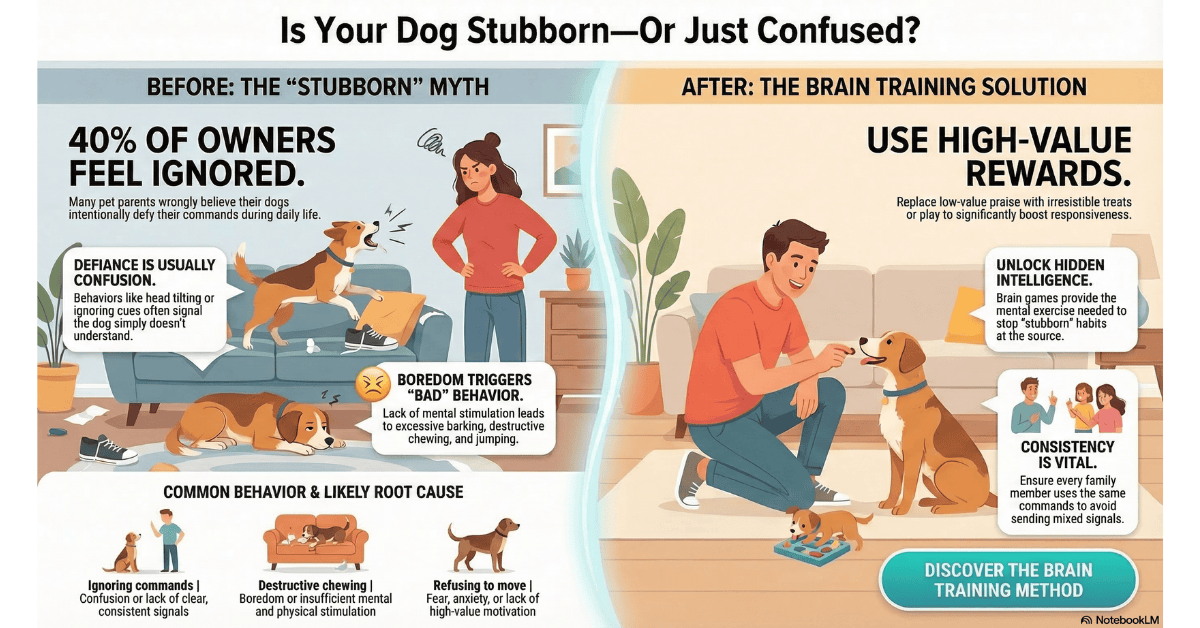
Did you know that nearly 40 per cent of pet parents believe their furry companions intentionally ignore them? It is a startling reality that often leaves people feeling disconnected from their beloved animals during daily walks.
Many owners face common struggles, such as excessive barking, destructive chewing, or separation anxiety. These behavioural hurdles can turn a peaceful home into a stressful environment very quickly.
When a stubborn dog won’t listen, it rarely stems from a desire to be dominant or mean. Instead, these dog behaviour problems usually indicate a need for clearer communication or better motivation.
Online training programs provide a convenient way to bridge this gap without leaving your home. By learning why your pup acts out, you can build a stronger bond and enjoy a much calmer life together.
Key Takeaways
- Stubbornness often signals confusion or a lack of motivation rather than a bad attitude.
- Consistency in commands is vital for helping animals understand what you expect.
- High-value rewards can significantly enhance your pet’s responsiveness to instructions.
- Environmental distractions are a leading reason why pets seem to ignore their owners.
- Modern online training tools provide accessible solutions for busy households.
- Mental stimulation is just as important as physical exercise for a well-behaved animal.
Understanding What Looks Like Stubborn Behaviour in Dogs
Dogs that appear stubborn may actually be struggling with stress, anxiety, or confusion. What owners perceive as defiance or stubbornness can often be a sign of underlying issues that need attention.
Dealing with a defiant dog can be challenging, but understanding the root cause of the behaviour is the first step towards effective dog obedience training. Dogs, like humans, can face various stressors and emotional challenges that manifest as behavioural issues.
Common Factors Contributing to Stubborn Behaviour:
- Stress and anxiety caused by environmental changes or past traumas
- Lack of clear communication and inconsistent training methods
- Insufficient mental and physical stimulation leading to boredom
- Fear and anxiety are triggered by specific stimuli or situations
Recognising these factors is crucial for developing a comprehensive approach to understanding dog behaviour. By acknowledging that stubbornness might be a symptom of a deeper issue, owners can begin to address the problem more effectively.
Effective dog obedience training is not just about correcting undesirable behaviour but also about understanding the emotional and psychological state of the dog. By doing so, owners can tailor their training methods to meet the specific needs of their dogs, leading to a more harmonious and obedient relationship.
Why Is My Dog So Stubborn? The Real Answer
Stubborn behaviour in dogs is often misunderstood, but there are real reasons behind it that can be addressed with the right approach.
Dogs aren’t being stubborn on purpose; they’re usually responding to their environment, training, or lack thereof. Understanding the root cause of your dog’s stubbornness is crucial for developing effective strategies to change their behaviour.
A common misconception is that dogs are stubborn due to dominance or disobedience. However, research and expert opinions suggest that most cases of stubbornness stem from confusion, lack of proper motivation, or underlying emotional issues such as fear or anxiety.
To address stubborn behaviour, it’s essential first to identify the underlying cause. This involves examining your dog’s training, environment, and overall well-being. By doing so, you can tailor your approach to meet your dog’s specific needs, whether it involves adjusting your training methods, providing more mental stimulation, or addressing any underlying emotional issues.
Tips for handling stubborn dogs include being patient, consistent, and positive in your training approach. Changing stubborn dog habits requires time, effort, and understanding. By adopting a compassionate and informed approach, you can help your dog overcome stubborn behaviour and strengthen your bond with them.
Reason 1: Your Dog Doesn’t Understand What You Want
One of the primary reasons your dog appears stubborn is that they don’t understand what you’re asking them to do. Dogs rely heavily on clear communication from their owners, and if the cues are unclear or inconsistent, it can lead to confusion.
Clear communication is key to effective dog training. When commands are vague or not well-defined, dogs can become uncertain about what behaviour is expected of them. This uncertainty can manifest as what appears to be stubbornness.
Signs Your Dog Is Confused, Not Stubborn
It’s essential to recognise the signs that indicate your dog is confused rather than being stubborn. Some common signs include:
- Tilting their head or looking puzzled when given a command
- Failing to respond to a command, not because they’re ignoring it, but because they don’t understand it
- Looking to you or others for guidance or cues
If you notice these signs, your dog is likely confused rather than being stubborn. Understanding this distinction is crucial for addressing the issue effectively.
How to Fix Communication Problems Fast
To resolve communication issues, ensure that your commands are clear, concise, and consistent. Here are some tips:
- Use clear and simple commands that your dog can easily understand.
- Be consistent in the commands you use and the hand signals associated with them.
- Use positive reinforcement to encourage good behaviour and avoid confusing your dog with negative reinforcement.
By improving your communication with your dog, you can significantly reduce the likelihood of them appearing stubborn due to confusion. Effective training is about clarity and consistency, and by focusing on these aspects, you can enhance your dog’s understanding and responsiveness to commands.
Reason 2: Lack of Proper Motivation and Rewards
A key factor behind a dog’s stubbornness is often the lack of suitable motivation and reward systems. Dogs are motivated by various factors, and what works for one dog may not work for another. Understanding what drives your dog is crucial to effective training.
Why Low-Value Rewards Don’t Work
Using low-value rewards can be counterproductive in dog training. If the reward is not significant enough, your dog may not be motivated to follow commands or behave as desired. For instance, if your dog is highly food-motivated, using praise alone might not be enough to keep them engaged.
Low-value rewards can lead to a lack of enthusiasm and interest in training. It’s essential to identify high-value rewards that your dog finds irresistible.

Finding What Truly Motivates Your Dog
To effectively motivate your dog, you need to discover what they value most. This could be high-value treats, praise, playtime, or a combination of these. Experimenting with different rewards will help you understand what drives your dog’s behaviour.
Some dogs are highly motivated by positive reinforcement techniques, such as clicker training. Others may respond better to reward-based training methods that incorporate their favourite toys or activities.
By identifying and using the right motivators, you can significantly improve your dog’s responsiveness to training and reduce stubborn behaviour.
Reason 3: Inconsistent Training and Mixed Signals
Mixed signals and inconsistent training can confuse dogs, leading to behaviours perceived as stubbornness. When different family members give varying commands or employ different training methods, it can be challenging for a dog to understand what is expected of them.
Consistency is key in dog obedience training. Dogs thrive on routine and clear communication. When the rules and expectations are not consistent, it can lead to confusion and frustration for the dog.
How Inconsistency Creates “Stubborn” Dogs
Inconsistency in training can manifest in various ways, such as different commands for the same action or varying rewards and punishments. For example, if you allow your dog to jump on the couch one day and then scold them for doing so the next day, you’re sending mixed signals.
This inconsistency can make a dog uncertain about what behaviour is acceptable, leading to what appears to be stubbornness. To avoid this, it’s essential to establish a unified training approach that everyone in the household follows.
Establishing Clear Rules and Boundaries
To effectively manage a stubborn dog, it’s crucial to establish clear rules and boundaries. Start by identifying the behaviours you want to encourage or discourage. Then, develop a consistent training plan that includes positive reinforcement techniques.
For instance, if you’re working on basic obedience commands like “sit” or “stay,” ensure that everyone uses the same command and hand signal. Consistency in your training methods will help your dog understand what you want them to do, reducing the likelihood of stubborn behaviour.
By implementing consistent ways to manage a stubborn dog, you can improve your dog’s responsiveness to commands and strengthen your bond with them. Remember, patience and persistence are key when teaching your dog new behaviours or correcting unwanted ones.
Reason 4: Your Dog Is Bored or Under-Stimulated
A lack of stimulation can lead to boredom, which is a common underlying cause of stubborn behaviour in dogs. Dogs are intelligent animals that require mental and physical stimulation to stay happy and healthy.
When dogs are not provided with adequate stimulation, they can become restless, destructive, or disobedient. This is often misinterpreted as stubbornness, but in reality, it’s a sign that they need more engagement and activity.
The Link Between Boredom and Defiant Behaviour
Boredom can lead to a range of behavioural issues in dogs, including destructive behaviour, excessive barking, and digging. When dogs are bored, they look for ways to entertain themselves, which can result in undesirable behaviours.
Signs of boredom in dogs include:
- Chewing or destroying furniture and other household items
- Excessive barking or howling
- Digging or attempting to escape
- Pacing or restlessness
Mental Stimulation and Brain Games for Stubborn Dogs
Providing mental stimulation is crucial to preventing boredom and related behavioural issues. Brain games and interactive toys can challenge your dog and keep them engaged.
Some effective ways to provide mental stimulation include:
- Interactive puzzle toys filled with treats
- Scent work and hide-and-seek games
- Obedience training and trick training
- Problem-solving activities, such as figuring out how to get a treat out of a jar

By incorporating these activities into your dog’s daily routine, you can help reduce boredom and prevent stubborn behaviour. Remember, a mentally stimulated dog is a happy and well-behaved dog.
Reason 5: Fear, Anxiety, or Stress
When dogs act stubbornly, it can sometimes be a sign of an underlying emotional issue, such as fear or anxiety. Dogs, like humans, can experience a range of emotions that influence their behaviour. Understanding the role of fear, anxiety, and stress in canine behaviour is crucial for addressing what appears to be stubbornness.
When Stubbornness Is Actually Fear
Fear and anxiety can manifest in various ways, including avoidance behaviours or defensive aggression, which might be misinterpreted as stubbornness. For instance, a dog that is fearful of loud noises may refuse to move forward during a walk. Recognising the signs of fear and anxiety is the first step in addressing the root cause of the behaviour.
Some common signs that a dog’s behaviour is driven by fear or anxiety include:
- Tucking their tail or avoiding eye contact
- Panting or pacing
- Refusing to follow commands or move in certain situations
Building Confidence Through Force-Free Training Methods
Force-free training methods prioritise building trust and confidence between the dog and its handler. This approach avoids punishment or negative reinforcement, which can exacerbate fear and anxiety. Instead, it emphasises positive reinforcement techniques that encourage desired behaviours.
A key aspect of force-free training is understanding and respecting the dog’s emotional state. By doing so, handlers can create a safe and supportive environment that fosters learning and reduces stress.
| Training Method | Description | Benefits |
|---|---|---|
| Positive Reinforcement | Encouraging good behavior builds trust. | Encouraging good behaviour builds trust. |
| Desensitization | Gradually exposing the dog to the feared stimulus at a controlled level. | Reduces fear response over time. |
| Counterconditioning | Associating the feared stimulus with a positive outcome. | Changes the dog’s emotional response to the stimulus. |
By adopting force-free training methods and understanding the emotional needs of their dogs, owners can effectively address behaviours that appear stubborn but are actually rooted in fear, anxiety, or stress.
Reason 6: Breed Characteristics and Natural Instincts
Understanding a dog’s breed-specific traits is crucial in addressing stubborn behaviour. Certain breeds have been developed over centuries for specific purposes, such as herding, hunting, or guarding, and these original functions have instilled unique characteristics and instincts in them.
For instance, breeds like Border Collies and Australian Shepherds are known for their high energy and strong herding instincts. These dogs might exhibit stubbornness if they don’t receive adequate physical and mental stimulation. On the other hand, breeds like Bulldogs and Pugs, known for their independent nature, might be more challenging to train due to their inherent stubbornness.

Understanding Breed-Specific Behaviour Traits
Different breeds have distinct behavioural traits shaped by their history and original purpose. For example, guard breeds like German Shepherds and Rottweilers are naturally protective and might be more inclined to assert their dominance. Understanding these breed-specific traits can help you tailor your training approach to your dog’s needs.
It’s also essential to recognise that while breed tendencies are significant, individual dogs within a breed can vary widely. Factors such as upbringing, socialisation, and training play a crucial role in shaping a dog’s behaviour.
Working With Your Dog’s Natural Tendencies
Rather than fighting your dog’s instincts, it’s more effective to work with them. For high-energy breeds, this may mean providing ample exercise and mental stimulation. For breeds with strong prey drives, incorporating activities that satisfy this instinct can be beneficial.
By understanding and respecting your dog’s breed characteristics and natural tendencies, you can develop a training plan that aligns with their inherent traits, making the training process more effective and enjoyable for both you and your dog.
Tips for Handling Stubborn Dogs Based on Breed Characteristics:
- Research your dog’s breed to understand their original purpose and inherent traits.
- Tailor your training and exercise routines to meet your dog’s breed-specific needs.
- Use positive reinforcement training methods that work with your dog’s natural tendencies.
Reason 7: Poor Impulse Control and Self-Control Skills
One of the key reasons behind a dog’s stubborn behaviour is their lack of impulse control and self-control skills. Dogs, especially those with high energy or strong instincts, may act on impulse without considering the consequences of their actions. This impulsivity can manifest as stubbornness, making training challenging.
What Is Dog Impulse Control Training
Dog impulse control training is a set of exercises designed to teach dogs to control their impulses and make better decisions. This type of training helps dogs learn to wait, not grab food from the counter, and not pull on the leash. Impulse control training is essential for dogs that are easily distracted or have a strong prey drive.
By teaching a dog to control their impulses, owners can reduce unwanted behaviours and improve their dog’s overall behaviour. Impulse control training involves a series of exercises that gradually increase in difficulty, helping dogs learn to make better choices in various situations.
Teaching Your Dog to Make Better Choices
To teach your dog to make better choices, start with simple exercises like “wait” and “leave it.” Begin by having your dog sit, then take a few steps back and say “wait.” If they get up, go back to the beginning and try again. Gradually increase the distance and time you’re away from your dog. Consistency and patience are key to successful impulse control training.
Another effective exercise is “leave it.” Place a treat in front of your dog and say “leave it.” If they try to take the treat, cover it with your hand and say “no.” When they leave the treat alone, praise them and reward them with a different treat. This exercise teaches your dog to control their impulses and make better choices.
Positive Dog Training Techniques That Actually Work
The journey to a well-behaved dog begins with embracing positive dog training techniques that actually work. Positive reinforcement training has emerged as a highly effective method for addressing stubborn behaviour in dogs. This approach focuses on rewarding desired behaviours rather than punishing undesired ones, creating a supportive and encouraging learning environment.
Reward-Based Training for Stubborn Dogs
Reward-based training is particularly effective for stubborn dogs as it motivates them to learn and obey commands. By using treats, praise, and affection as rewards, dog owners can encourage good behaviour. The key is to identify what motivates your dog the most and use that as a reward. For instance, some dogs are highly food-motivated, while others may respond better to play or verbal praise.
Implementing Reward-Based Training:
- Identify your dog’s favourite treats or toys to use as rewards.
- Be consistent in rewarding desired behaviours immediately after they occur.
- Gradually phase out rewards as the behaviour becomes more consistent.
Timing and Consistency in Training Sessions
Timing and consistency are crucial elements in dog training. The timing of rewards and corrections has a significant impact on how quickly and effectively a dog learns. Rewards should be given immediately after the desired behaviour to create a clear association. Consistency in training sessions ensures that the dog understands what is expected of them.
The Importance of Timing:
- Reward your dog the moment they perform the desired action.
- Ensure all family members are using the same commands and rewards.
- Keep training sessions short and frequent to maintain your dog’s attention.
By focusing on positive dog training techniques, such as reward-based training and maintaining timing and consistency, dog owners can effectively address stubborn behaviour and foster a well-behaved and obedient pet.
When Your Stubborn Dog Won’t Listen: Troubleshooting Tips
When dealing with a stubborn dog that refuses to listen, it’s essential to troubleshoot the root cause of the issue. A stubborn dog that refuses to listen can be frustrating, but by identifying the underlying issue, you can develop an effective plan to address it.
What to Do When Your Dog Ignores Commands
If your dog ignores commands, the first step is to assess the situation and determine why they’re not responding. Your dog may be distracted, unmotivated, or may not understand what you want. To address this, try to minimise distractions and use high-value rewards to motivate your dog.
Another approach is to review your training techniques and ensure that you’re using clear, consistent commands. Make sure you’re not inadvertently reinforcing bad behaviour and that you’re providing enough opportunities for your dog to practice and learn.
Adjusting Your Training Approach
Adjusting your training approach can be crucial when dealing with a stubborn dog that won’t listen. Consider changing your reward structure or incorporating new training methods to keep your dog engaged. It’s also essential to be patient and consistent, as changing behaviour takes time and effort.
By troubleshooting the root cause of the issue and adjusting your training approach, you can help your stubborn dog become more responsive and obedient. With patience, persistence, and the right techniques, you can overcome the challenges of training a stubborn dog.
Using an Online Dog Training Program for Stubborn Dogs
For dog owners struggling with stubborn pets, finding the right training solution can be a game-changer. Online dog training programs have become increasingly popular for their convenience and effectiveness in addressing behavioural issues in dogs.
Benefits of Structured Online Training
Structured online training offers several benefits for dog owners dealing with stubborn dogs. It provides convenience, allowing owners to train their dogs at home and at their own pace. Additionally, online programs often offer personalised learning paths tailored to the dog’s specific needs and behavioural issues.
Another significant advantage is access to expert trainers and a community of dog owners facing similar challenges. This support system can be invaluable for owners who feel isolated in their training efforts or need guidance on specific issues.

What to Look for in a Quality Program
When selecting an online dog training program, several key features should be considered. First, ensure the program is based on positive reinforcement techniques, which are widely recognised as the most effective and humane training method.
A comprehensive curriculum that covers a wide range of topics, from basic obedience to addressing specific behavioural issues, is also crucial. Furthermore, look for programs that offer support from experienced trainers, whether through live sessions, email, or community forums.
| Feature | Description | Importance Level |
|---|---|---|
| Positive Reinforcement | Training method focusing on rewarding desired behaviors | High |
| Comprehensive Curriculum | Training method focusing on rewarding desired behaviours | High |
| Trainer Support | Access to expert trainers for guidance and feedback | Medium |
| Community Access | Opportunity to interact with other dog owners and trainers | Medium |
| Flexibility | Ability to train at your own pace and schedule | High |
Creating a Long-Term Plan to Change Stubborn Dog Habits
A long-term plan is essential for transforming stubborn dog habits into obedient behaviour. Changing stubborn dog habits is not an overnight process; it demands patience, consistency, and a well-structured approach. As emphasised by dog training experts, patience and consistency are key to successful dog training.
“The key to unlocking your dog’s potential is not just through training, but through understanding and patience,” says renowned dog trainer Ian Dunbar. This quote highlights the significance of a long-term commitment to modifying persistent dog behaviours.
Setting Realistic Training Goals
Setting realistic training goals is the first step towards creating a successful long-term plan. It’s essential to understand that every dog is unique, with its own distinct needs and learning capabilities. When setting goals, consider your dog’s breed, age, and individual temperament. For instance, some breeds are naturally more stubborn due to their independent nature, as seen in breeds like Siberian Huskies or Afghan Hounds.
To set achievable goals, start by identifying specific behaviours you want to change. Break down larger goals into smaller, manageable tasks. For example, if your goal is to improve your dog’s responsiveness to commands, start by focusing on one command at a time. Use positive reinforcement techniques, such as treats and praise, to encourage good behaviour.
Tracking Progress and Staying Motivated
Tracking your dog’s progress is vital to staying motivated and adjusting your training plan as needed. Keep a training journal to record your dog’s responses to different commands and exercises. This will help you identify patterns and areas that need more attention.
Staying motivated can be challenging, especially when progress appears to be slow. Celebrate small victories along the way, and don’t hesitate to seek professional help if you’re facing difficulties. Joining a dog training community or working with a professional dog trainer can provide valuable support and guidance.
By following these steps and maintaining a commitment to your long-term plan, you can effectively change stubborn dog habits and strengthen your bond with your pet.
Struggling With a Stubborn Dog That Won’t Listen?

If your dog ignores commands, pulls on the leash, or continues to exhibit undesirable behaviours, the problem may not be stubbornness — it’s often a lack of mental stimulation and inadequate training.
That’s exactly what Brain Training For Dogs – Adrienne Farricelli Online Dog Trainer helps fix.
Inside This Powerful Dog Training Program You’ll Discover:
✔ 21 brain games that unlock your dog’s hidden intelligence
✔ Step-by-step training system created by a certified CPDT-KA professional trainer
✔ Force-free, science-based methods that eliminate bad behaviours
✔ Solutions for barking, chewing, jumping, digging, and leash pulling
✔ Video demonstrations and easy instructions anyone can follow
✔ Techniques that build a stronger bond between you and your dog
This proven system has already helped thousands of dog owners turn stubborn dogs into obedient, well-behaved companions.
🔥 Click here to discover the simple brain-training system that can transform your dog’s behaviour starting today.
👉 See the Brain Training For Dogs Program Now
Conclusion
Understanding why your dog is being stubborn is crucial to addressing the issue effectively. By recognising that stubbornness is often a symptom of underlying issues such as a lack of clear communication, inadequate motivation, or breed-specific traits, you can tailor your approach to your dog’s specific needs.
Training a stubborn dog requires patience, consistency, and positive reinforcement techniques. By applying the strategies outlined, such as improving communication, using high-value rewards, and providing mental stimulation, you can overcome behavioural problems in dogs and strengthen your bond with your pet.
Resources from reputable sources can provide valuable insights and guidance on dog training and behaviour. By adopting a comprehensive and informed approach, you can help your dog become a well-behaved and loving companion, addressing the question of why your dog is so stubborn with effective solutions.
FAQ
Why is my dog so stubborn when I give a simple command?
Most of the time, what we perceive as a dog being “difficult” is actually one of several common dog behaviour problems, such as lack of clarity, fear, or low motivation. When understanding dog behaviour, it is essential to realise that dogs aren’t usually trying to be defiant; they may not see the benefit of obeying at that moment or may be too distracted to process your request. Using positive dog training techniques helps bridge this communication gap.
What are the best tips for handling stubborn dogs that refuse to walk?
When dealing with a defiant dog on a leash, the goal is to make moving forward more rewarding than standing still. One of the most effective tips for handling stubborn dogs is to use high-value lures, like Stella & Chewy’s Freeze-Dried Raw Coated Biscuits, to encourage movement. Avoid pulling back on the leash, as this often triggers a dog’s natural opposition reflex, making them pull in the opposite direction.
How can I stop my dog from ignoring commands when there are distractions?
If your stubborn dog won’t listen in the park but obeys perfectly in the kitchen, they haven’t “generalised” the behaviour. To fix this, you need to practice dog obedience training in gradually more challenging environments. Start in a quiet hallway, move to the backyard, and then proceed to the front porch. This step-by-step process is essential for training a stubborn dog to focus on you regardless of what is happening around them.
Are brain games for stubborn dogs actually effective for improving behaviour?
Absolutely. Many ways to manage a stubborn dog involve addressing their mental needs. Brain games for stubborn dogs, such as hide-and-seek or using a Nina Ottosson Dog Brick Puzzle, provide essential mental stimulation for dogs. A mentally tired dog is much more likely to be cooperative and less likely to engage in “stubborn” behaviours rooted in boredom or pent-up energy.
Why don’t dogs obey even when they know the command?
There are several reasons why dogs don’t obey, but the most common is a lack of a “paycheck.” If the reward isn’t worth the effort, the dog may choose to ignore you. Additionally, dogs ignore commands when they are feeling anxious or overwhelmed. In these cases, shifting to force-free training methods can help build a safer, more trusting environment where the dog feels comfortable responding.
What is the first step in changing stubborn dog habits?
The first step in changing stubborn dog habits is evaluating your own consistency. If you sometimes let your dog jump on guests but scold them other times, the dog becomes confused. Establishing clear, unwavering boundaries and utilising dog impulse control training—such as the “Stay” or “Leave It” commands—will teach your dog how to make better choices and enhance their overall responsiveness.
Is there a specific resource that explains how to effectively train a stubborn dog?
Yes, many professional trainers recommend structured online courses, such as those offered by SpiritDog Training or the AKC’s Good Dog! Helpline. These programs provide a roadmap for training a stubborn dog by focusing on relationship-building and science-based reinforcement, rather than old-fashioned correction-based methods.




Я присмотрелся к [url=https://zeekrfvto.ru]zeekr сайт[/url] и решил устроить тест-драйв.
Планируется дальнейшее развитие модельного ряда и сервисной сети.
Приглашаем вас принять участие в [url=https://bleskfest.ru/]участвовать в танцевальном конкурсе[/url] и показать своё мастерство на лучшей сцене сезона.
Зрелищность номеров усиливается качественным звуковым сопровождением и сценическим светом.
Компания предлагает [url=https://arenda-avtomobilya-s-voditelem03.ru/]аренда авто в новосибирске с водителем[/url] по выгодным тарифам и с профессиональными водителями.
Аренда авто с водителем удобна для деловых встреч, городских прогулок и трансферов в транспортные узлы.
my response https://daobase.io/
click https://yomix.biz/
visit the site https://daobase.online